Why Athletes ( actually all of us ) Need Sleep:
 The Consequences of Sleep Deprivation: Now, let’s talk about the dark side: what happens when you don’t get enough sleep.
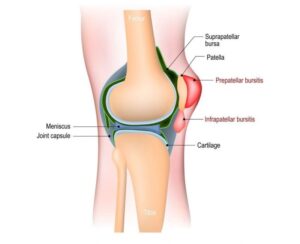
Distinct clinical features between patellar tendinopathy and infra patellar bursitis.
Patellar tendinopathy also known as jumper’s knee is a condition characterized by degeneration and inflammation of the patellar tendon. It commonly affects athletes involved in jumping sports such as basketball and volleyball. The primary symptom of patellar tendinopathy is localized pain and tenderness just below the knee cap. The pain is typically aggravated by activities that involve jumping or squatting. Patients may also experience morning stiffness and pain with prolonged sitting or climbing stairs.
On the other hand infrapatellar bursitis also known as clergyman’s knee is the inflammation of the bursa located beneath the patellar tendon between the tendon and the tibial tuberosity. It is commonly observed in people who frequently kneel such as carpet layers and gardeners. The cardinal symptom of infrapatellar bursitis is focal swelling and tenderness below the patella. Unlike patellar tendinopathy the pain associated with bursitis is usually more diffuse and can be worsened by activities that put pressure on the knee such as kneeling or direct trauma.
Differential diagnosis between patellar tendinopathy and infrapatellar bursitis can be challenging due to overlapping clinical features. However a thorough history and physical examination can aid in distinguishing between the two conditions. As Licensed Massage therapist we should pay attention to the location and nature of pain aggravating factors and the presence of swelling or tenderness.
To further confirm the diagnosis diagnostic imaging techniques like ultrasound or MRI may be utilized. Ultrasound can assess the tendon structure and detect abnormalities such as thickening or neovascularization which are characteristic of patellar tendinopathy. MRI provides detailed anatomical visualization helping to identify signs of inflammation fluid accumulation or structural changes in both the tendon and the bursa.
Additionally other examinations such as plain X-rays may be performed to rule out fractures or other knee joint pathologies that could present with similar symptoms.
Once a definitive diagnosis has been made the treatment approach for patellar tendinopathy and infrapatellar bursitis may differ. Patellar tendinopathy is typically managed with a combination measures such as rest , physical therapy , Integrated Movement Specialist , Massage therapy and eccentric strengthening exercises.
In the case of infrapatellar bursitis the treatment focuses on reducing inflammation and relieving symptoms. Conservative management options include rest avoidance of aggravating activities,Heat, anti-inflammatory medications and the use of padding or protective knee sleeves. In more severe or chronic cases aspiration of the bursa fluid or corticosteroid injections may be necessary. To learn more about this, Or becoming an Integrated Movement Specialist (IMI) or Learn Massage therapy contact me at 630-968-7827 or email me at [email protected]
.
As Sports Massage Therapist and Movement coaches we hold a crucial responsibility in shaping the trajectory of our athletes/ clients performance journey. One paramount aspect often overlooked is the significance of proper movement mechanics in thwarting sports-related injuries.
Athletes might possess incredible strength and endurance, but without sound /optimal movement patterns, they’re walking a tightrope between excellence and injury. 🤕 Here’s why focusing on movement mechanics is non-negotiable:
Injury Prevention: Flawed mechanics create imbalances that can lead to overuse injuries. By addressing movement dysfunctions early, we’re reinforcing the foundation for a long and prosperous athletic career.
Optimal Performance: Efficient movement patterns translate to enhanced performance. A body that moves seamlessly expends less energy, allowing athletes to channel their efforts where they matter most.
Longevity: Think of movement mechanics as an investment in an athlete’s future. By guiding them to move the right way now, we’re setting them up for a healthier and more fulfilling journey in sports.
Here are some strategies we can adopt as coaches:
✅ Functional Assessments: Regularly evaluate athletes’ movement patterns to identify weaknesses or imbalances that could lead to injuries down the line.
✅ Tailored Corrective Exercises: Design targeted exercises that address specific movement deficiencies, gradually rewiring the body’s mechanics.
✅ Education: Empower athletes with knowledge about the importance of proper movement. When they understand the “why,” compliance becomes natural.
Let’s embark on a mission to not just build strong athletes, but also athletes who move with precision and grace. By prioritizing movement mechanics, we’re not just mitigating risks – we’re nurturing athletes who are resilient, high-performing, and poised for long-term success. 🌟
Remember, behind every powerful performance is a foundation of well-executed movements.
If you would like to learn more about this
contact me at 630-968-7827
or www.sohmar.com
Did you know that getting your tires aligned has similar benefits to the joints of your body being in good alignment?
It’s true.
The benefits of getting your tires aligned include:
Compare that when your joints are aligned (Which are over 300 in your body):
What are common issues that can lead to joints being out of alignment?
What can you do to get your joints in better alignment?
We will work together to keep your joints aligned using the best tools and strategies specific to your needs, wants, and goals.
Visit www.sohmar.com
Chronic pain is only incomprehensible if…
…the wrong model is being used.
The biomedical model does not explain chronic pain—the variety of expressions people describe. And that’s many people; millions across the globe.
Each has their own experience of a painful moment, generated top-down as a best guess to explain their lived world.
That’s the modern take, which does explain the variety and the many different scenarios that create confusion.
But the confusion stems from looking through the wrong lens.
This is not a blame-game however.
People are trying to make sense of it all—both the person having the lived experience and the clinicians attempting to help.
The sooner that society and healthcare moves to a person-first, whole approach, the sooner suffering will be eased on a greater scale (IMHO).
What does that mean?
Instead of trying to squeeze people into pre-determined boxes, we can meet them where they are and fit the model to them.
There is no single way to help a person suffering chronic pain—no approach, no therapy, no treatment.
Seeing and listening to the person is the first step.
What is happening in their world?
What is their picture of success?
Now we can begin to help them understand their experiences and offer ways forward in their chosen direction..
It is empowering, respecting autonomy and encouraging.
Getting better is an active process on the part of the person, often requiring collaboration with a compassionate clinician who is the guide (on the side, not a sage on the stage 😄).
Embodied cognition, enactivism and predictive processing offer ways of understanding what is happening and how. Much more work needs to be done looking at chronic pain through these lenses, yet they are able to explain people’s experiences, biology and other measurables such as investigations. In turn, this leads to a wide range of skills and strategies that form a daily practice to build wellness and live a best life.
If you would like to learn more about Helping others Our Massage and Reflexology Courses are a Good start
www.sohmar.com

Clients often say, “I’m not sure what we just did, but it was like magic my legs feel so much lighter or my neck is moving so much better”. Well, we are hardly magicians. We don’t wear magic hats and pull rabbits from them.
What we do is not magic, but the magic feeling happens in the details and you too can experience the magic.

Getting your body to move and feel better through exercise requires three details:
As you know exercise comes in all forms. If you feel a need to stretch during or after exercise you likely missed or compromised one of the above.
Compromise happens for many reasons, the weight was too heavy, fatigue, too much time, previous injuries, poor movement habits, poor exercise habits, pushing yourself beyond the point where your body can maintain the three details above.
None of this means you should not lift heavy weight or exercise for an extended period of time, or that you have never recovered from injuries or that you will never feel tight.
If you feel chronically tight or always feel a need to stretch, your body is sending you a clear message that something in your posture, movements, habits, etc., makes it feel misaligned unsteady, or off balance and it feels a need to tighten down to keep it safe from harm.
You are likely familiar with the phrase ‘batten down the hatches’. When a captain knows a storm is coming they will ‘batten down the hatches to keep things safe and in place. This is what your body is doing when you get tight. It is preparing for something bad and tightening things down to keep your body safe.
This some of what we go over in Our Massage therapy Program
If you would like to learn more about this or you are interested in Learning Massage contact me at [email protected]
Do you remember when your teacher would say keep your eyes on your own paper! Often, it was because they did not want you to copy someone else’s work or, well, cheat to get the answer.
This example applies to health and fitness as well. There are ways to ‘cheat’ and just like cheating, the results are not the best assessment of you and ultimately will lead to failure and frustration.
Another challenge that occurs too often is following a program meant for someone else’s body and goals.
You see a person who is in great shape, and you want to look like them. You want to feel in your body how you imagine they feel in theirs.
You follow them on social media, and you do ALL the exercises they do and find you are not getting the results you were hoping for, looking like them, and feeling the way you imagine they feel.
There are some excellent reasons you are not having success.
#1 You are not that person.
Your story is not theirs. Even if you find yourself saying that person is my age and they can do x,y, and z, why can’t I?
You can be me the same sex, age weight and come from the same town, your bodies, lifestyles, activities, work, stress, family life, medical history, etc. are different. Just because you have some characteristics in common, you are not the same.
You can only compare yourself to yourself, period.
#2. Just because someone looks good to you physically, you are entirely unaware and uninformed about how they ‘feel’ in their body.
We see client after client who appears to be in great shape and has worked out for years, yet; they come to see us because their body is breaking down, they have injuries that impede them from being active and enjoying their favorite activities.
So the moral of this newsletter is an old one. Just like your teacher told you in elementary school, don’t copy someone else’s work.
If you do, you will likely only have short-term success, or the work could be wrong, and you will continue down a road filled with frustration and possible injuries.
How do you know what is right for you?
When you have answered these questions, you have put value into why you want to do the work. There is an emotional connection to motivate you.
Then reach out to us. at www.sohmar.com or call 630-968-7827
It is time for you to do your own work.
We will discuss your story with you, your medical history, goals, your why, values, and together make a plan tailored to you.
Next, we will take a thorough assessment of your starting point so you take the necessary steps to confidently participate in the activities you need, want, and love to do.
“If you do the work you get rewarded. There are no shortcuts in life.”
― Michael Jordan
Add these GOOD habits to your day and start feeling and moving better!
We always hear about bad habits. In today’s newsletter I am going to share two GOOD habits you can add to your day to help start feeling better in your body.
#1 Posture checks
Some people think posture does not matter. Well, we disagree.
How you sit or stand for a long time can affect how you feel in your body. However, ideal posture should not require a lot of muscular effort.
Example: When you are sitting at your desk.
Sit on your SITS bones. This provides you the broadest base to sit upon and will ease pressure on your low back.
Let your collar bones go long from shoulder to shoulder.
Position your screen at a height in which you do not have to flex or extend your kneck to look at it.
Be sure to take regular breaks. Stand up, move around and reset your good posture.
For a reminder of how to sit in optimal posture especially how to sit on your SITS bones click here to watch the video.
#2 Practice three-dimensional breathing
We will often recommend doing this before you get out of bed and when you go to bed. Ensure your head and neck are supported and bend your knees, so your feet are flat on the bed.
This will help put you in the best alignment and make the breathing practice that much easier and beneficial.
You can easily incorporate three-dimensional breathing throughout your day as well.
Stand up and reposition yourself in your chair. As best you can, position yourself on your SITS bones, feet flat on the ground and close your eyes.
Practicing three-dimensional breathing:
As the name suggests, we want to make sure your diaphragm which is a three-dimensional muscle and one of the primary breathing muscles is being fully and gently accessed during the practice.
To help slow your breath down, inhale and exhale fully and gently through your nose. Try to breathe in for 3 seconds and exhale for 5-6 seconds.
As you breathe in, imagine your breath gently going down all sides of your rib cage and as you exhale, imagine the breath rising inside your rib cage on all sides of your rib cage, front, back, and sides.
Imagine the lit-up area in the picture is your breath gently reaching all sides of your rib cage.

Adding good habits like posture checks along with three-dimensional breathing breaks will help keep your body mobile, including common areas of stiffness like your upper back, neck, and shoulders.
I highly encourage you to add these simple GOOD habits to your day. I know they work because I use them. Give them a try for the next week and let me know how you feel. I would love your feedback!
Helping you develop good habits during exercise and how you move through the activities you need, want, and love to do is our specialty.
If you are looking for more help on adding good habits to your life to keep you doing the activities you need, want, and love to do, reach out today. We will provide a comprehensive assessment and create a personalized program designed to meet your needs and wants.
We love sharing helpful strategies with you. If you know of someone who may benefit from this newsletter be sure to SHARE! Thank you
Mike Mcaleese LMT, IMS
630-968-7827
www.sohmar.com
Subject: Get to know your rotator cuff and its dos and don’ts.
The rotator cuff and the muscles that make it up are often the sources of shoulder impingement, tendonitis, and tears.
Four key muscles make up your rotator cuff. There is also a fifth muscle that helps the rotator cuff group.
The supraspinatus sits in a groove on the top of the shoulder blade and attaches to your humerus.
The infraspinatus is on the back bottom side of your shoulder blade and connects to your humerus.
The subscapularis sits on the front of your shoulder blade and attaches to your humerus.
Your teres minor attaches to the outer edge of your shoulder blade and connects to your humerus.
The 5th muscle that assists the rotator group is a portion of your biceps muscle.
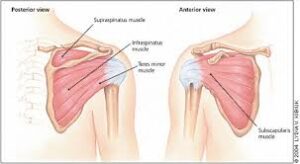 While individually they create action on your shoulder, together they help stabilize or keep your humeral head or the top of your humerus bone centered in the socket.
When the humeral head or the top of the arm bone is no longer centered in the socket (generally moves forward in the joint), you may feel a pinching sensation when raising the arm overhead.
Wear and tear, shoulder impingement, rotator cuff tendinitis, tears, or bursitis start to occur when these muscles don’t work equally together.
How do you avoid this happening or stop it from getting worse?
Maintain or create more optimal alignment of your shoulder joint.
Generally, we release large muscles that are tight. Tight muscles of the shoulder can often be the lats or teres major. Following the release, use an activation exercise like an isometric of the shoulder joint’s deep muscles. The isometric helps center the bones in the joint by using the deep stabilizing muscles. Finally, follow that up using proper setup or cues that help maintain the appropriate alignment for each exercise or activity.
Avoid the cues and set up of pull the shoulders down and back for posture and exercise. These recruit large muscles like that lats that can contribute to pulling the humerus out of alignment.
Have questions? Reach out, to us at [email protected] or call 630-968-7827 I an assess and find the best program for you.
Sincerely.
Michael McAleese LMT, IMS
Follow me on Instagram @sohmar_ims_lmt or @sohmar_massage_school
Do you remember that old song, Them Bones?
We got the finger bones
Connect the hand bones
Connect the arm bones
Connect the shoulder bones
The song does simplify anatomy a bit and yet, speaks the truth.
Various parts of our body are intimately connected. The bones are connected via muscles, tendons, fascia, etc.
Anatomy can be complicated yet, this somewhat silly song helps explain how and why less than optimal shoulder alignment or position can contribute to common issues like:
What does the optimal shoulder alignment look like? To be clear, there is no such thing as perfect. However, the best position is one that is sustainable and efficient.
This means it does not require a lot of effort to maintain and does not create excess wear and tear on your joints.
There should not be a large sloping from your ear to the end of your shoulder. This position creates a very inefficient place to start to raise the arm for activities.

Closer to optimal, the shoulders are relatively even. It makes sense that they should not slope as we carry things upon them.

Things to avoid to help improve your shoulders especially if you see them slope down and away from your ears.
AVOID:
DO:
If you notice, all the DO cues are light and easy. Literally, think and imagine. If we try to do these things, we over recruit muscles and, then it becomes less sustainable.
If you use these cues while exercising it may feel more challenging to lift as much weight or do as many repetitions as you may regularly do and that is ok. The other position of squeeze and pull the shoulders are compensations that allow you to move and lift more.
They also create wear and tear on your shoulder joint and your spine especially your cervical spine or neck. You may also find it easy to breathe as well. That is just a bit of a bonus.
We hope this week’s newsletter gave you some insight and practical tools.
If you have questions please reach out to us at: 630 -968-7827 or email me at [email protected] We can assess and find the best strategies for you and your body. If you think this may help someone you know, please feel free to pass it along.
Sincerely,
Mike McAleese LMT IMS
follow me on Instagram @sohmar_ims_lmt or @sohmar_massage_school